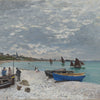
The Beach at Sainte-Adresse
Claude Monet
France
Configure your print
- Original Artwork
- Open Edition Prints available

The Beach at Sainte-Adresse
image
About The Artwork
expand_more
In the summer of 1867, Claude Monet stayed with his aunt at Sainte-Adresse, an affluent suburb of the port city Le Havre in northern France. The artist was familiar with the landscape, having grown up in the area, but the region changed significantly during his lifetime. The expansion of the country’s rail network turned this small, rural fishing village into a seaside resort for tourists. Here, Monet hinted at this transformation. The viewer is immediately drawn to the visible aspects of local life dark-sailed fishing boats drift in the water, with groups of fishermen, their equipment, and other craft on the shore. The beached boats frame two figures sitting on the shoreline, highlighted by a few strokes of red and yellow paint: a man in a dark hat and suit looks through a telescope, accompanied by a woman wearing a straw hat with a scarlet ribbon. The presence of this couple—undoubtedly vacationers, given their fashionable attire changes what might have been a traditional coastal scene into a painting of modern life, one of the artist’s first explorations of tourism.
Monet began this painting outdoors and revised it later in his studio. Conservation research has revealed that he changed his mind about the composition while he worked: he initially included other tourist figures and yachts in the scene but later painted over these details, shifting his focus to the fishermen, the aspect of life in Sainte-Adresse that he knew best.
Monet’s seascapes from this summer are markedly different from those painted only a few years earlier, and Beach at Sainte-Adresse exemplifies his evolving painting technique. It also foreshadows some of the qualities that became characteristic of the Impressionist movement, which is perhaps why Monet chose to show it at the second Impressionist exhibition in 1876, nearly ten years after he painted it.
local_shipping
Shipping & Returns
expand_more
Processing & Delivery
Please allow 7-10 business days for your order to be processed and prepared for shipping. Note that delivery times vary depending on where your artwork is shipped from. You can see an approximate delivery range after you input shipping information at checkout. We’ll provide you with tracking info and an estimated delivery date after your order ships.
Returns
We want you to be 100% satisfied with your new artwork. That’s why we give you 14 days from the date you receive your artwork to let us know if it’s not the right fit for you. Contact us during that timeframe, and we’ll get started on your hassle-free return. Review our full Return Policy here.
send
Ask The Artist
expand_more
Have a question for the artist? Send them an email and we'll get back to you ASAP.
Artwork Type: Print
About the artist

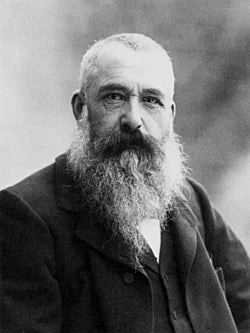
Claude Monet, born in Paris in 1840, was raised on the Normandy coast in Le Havre, where his father sold ships’ provisions. He gained a local reputation as a caricaturist while still a teenager, and landscape painter Eugène Boudin invited the budding artist to accompany him as he painted scenes at the local beaches. Boudin introduced Monet to plein air (outdoor) painting, which would prove a decisive influence in his career.
Monet went to Paris in 1862 to study painting and there befriended fellow students Auguste Renoir, Alfred Sisley, and Frédéric Bazille, who would later form the core group of the original impressionists. By the end of the 1860s Monet had largely abandoned ambitious, large-scale figurative painting in favor of smaller, spontaneous landscape works executed en plein air.
Monet fled to London during the Franco-Prussian War, and in late 1871 settled at Argenteuil, a suburb just west of Paris that maintained its rustic charm even as it underwent rapid modernization. From 1872 to 1876 Argenteuil became the hub of what would soon be known as impressionist painting. Monet and his colleagues organized an exhibition of their work in Paris in 1874; one of Monet’s exhibited works, Impression, Sunrise (1873), a loosely painted sketch of an industrial seascape, led critics to derisively dub the group “the impressionists.” Financial difficulties forced Monet to relocate to Vétheuil in 1878, and a few years later, in 1883, he settled in Giverny, where he would live for the rest of his life.
You might also like
FREE SHIPPING ON ALL ARTWORK!