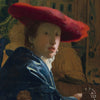
Girl with the Red Hat
Johannes Vermeer
Netherlands
Configure your print
- Original Artwork
- Open Edition Prints available

Girl with the Red Hat
image
About The Artwork
expand_more
Girl with the Red Hat is one of Johannes Vermeer’s smallest works, and it is painted on panel rather than on his customary canvas. The girl has turned in her chair and interacts with the viewer through her direct gaze. Girl with the Red Hat is portrayed with unusual spontaneity and informality. The artist’s exquisite use of color is this painting’s most striking characteristic, for both its compositional and its psychological effects. Vermeer concentrated the two major colors in two distinct areas: a vibrant red for the hat and a sumptuous blue for the robe. He then used the intensity of the white cravat to unify the whole.
Following in his father’s footsteps, Vermeer also was an art dealer in Delft. There is no documentation of his artistic training or apprenticeship, but in 1653 he became a master in the Saint Luke’s Guild in Delft; he would serve as head of that guild four times in the 1660s and 1670s. Although he was well regarded in his lifetime, he was heavily in debt when he died in 1675. Only in the late 19th century did Vermeer achieve widespread fame for his intimate genre scenes and quiet cityscapes.
local_shipping
Shipping & Returns
expand_more
Processing & Delivery
Please allow 7-10 business days for your order to be processed and prepared for shipping. Note that delivery times vary depending on where your artwork is shipped from. You can see an approximate delivery range after you input shipping information at checkout. We’ll provide you with tracking info and an estimated delivery date after your order ships.
Returns
We want you to be 100% satisfied with your new artwork. That’s why we give you 14 days from the date you receive your artwork to let us know if it’s not the right fit for you. Contact us during that timeframe, and we’ll get started on your hassle-free return. Review our full Return Policy here.
send
Ask The Artist
expand_more
Have a question for the artist? Send them an email and we'll get back to you ASAP.
Artwork Type: Print
About the artist

The life and art of Johannes Vermeer are closely associated with the city of Delft. He was born in Delft in 1632 and lived there until his death in 1675. His father, Reynier Vermeer, was a silk weaver who produced caffa, a fine satin fabric, but in 1631 he also registered in the Saint Luke’s Guild in Delft as a master art dealer. By 1641 he was sufficiently prosperous to purchase a large house, the “Mechelen,” which contained an inn on the market square in Delft and from which he probably also sold paintings. When Reynier died in 1652 Johannes apparently inherited his business. By that time he must have already decided on a career as a painter. It is assumed that he trained in Delft, perhaps with Bramer, Leonard, who seems to have had close associations with Vermeer’s family, or with Fabritius, Carel. No documents, however, exist about his artistic training or apprenticeship, and he may have studied elsewhere, perhaps in Utrecht or Amsterdam.
Vermeer, who was baptized on October 31, 1632, in the Reformed Church in Delft, was raised a Protestant. In April 1653, however, he married into a Catholic family and seems to have converted to Catholicism shortly before that date to placate his future mother-in-law, Maria Thins, who lived in the so-called Papenhoek (Papists’ Corner) of Delft, adjacent to the Jesuit church on the Oude Langendijck, one of two hidden churches where Catholics could worship. Vermeer and his wife, Catharina Bolnes, eventually moved into her house. They named their first daughter Maria and their first son Ignatius, after the patron saint of the Jesuit order.
Vermeer became a master in the Saint Luke’s Guild on December 29, 1653. His early aspiration was to be a history painter, and his first works were large-scale mythological and religious paintings. Shortly thereafter he began to paint the genre scenes, landscapes, and allegories for which he became so renowned. Although Vermeer’s subject matter changed in the mid-1650s, he nevertheless continued to imbue his later works with the quiet, intimate moods he had preferred in his early history paintings.
You might also like
FREE SHIPPING ON ALL ARTWORK!