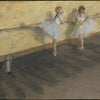
Dancers Practicing at the Barre
Edgar Degas
France
Configure your print
- Original Artwork
- Open Edition Prints available

Dancers Practicing at the Barre
image
About The Artwork
expand_more
The watering can, visible at left, was a standard fixture in ballet rehearsal rooms; water was sprinkled on the floor to keep dust from rising when ballerinas danced. Degas also used the watering can as a visual pun: its shape is mimicked by that of the dancer at right. Shown at the 1877 Impressionist exhibition, the painting was given by Degas to the collector Henri Rouart as a replacement for an earlier work (now lost), which the artist altered and accidentally destroyed. Louisine Havemeyer purchased it from Rouart's estate sale in 1912, for $95,700, a record price for a work by a living artist.
local_shipping
Shipping & Returns
expand_more
Processing & Delivery
Please allow 7-10 business days for your order to be processed and prepared for shipping. Note that delivery times vary depending on where your artwork is shipped from. You can see an approximate delivery range after you input shipping information at checkout. We’ll provide you with tracking info and an estimated delivery date after your order ships.
Returns
We want you to be 100% satisfied with your new artwork. That’s why we give you 14 days from the date you receive your artwork to let us know if it’s not the right fit for you. Contact us during that timeframe, and we’ll get started on your hassle-free return. Review our full Return Policy here.
send
Ask The Artist
expand_more
Have a question for the artist? Send them an email and we'll get back to you ASAP.
Artwork Type: Print
About the artist

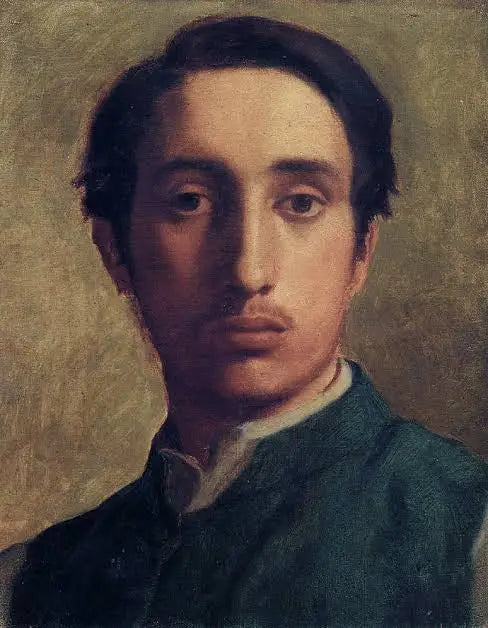
The eldest son of a Parisian banker, Edgar Degas reinforced his formal academic art training by copying Old Master paintings both in Italy, where he spent three years (1856–1859), and at the Louvre. Degas early on developed a rigorous drawing style and a respect for line that he would maintain throughout his career. His first independent works were portraits and history paintings but in the early 1860s he began to paint scenes from modern life. He started with the world of horse racing and by the end of the 1860s had also turned his attention to the theater and ballet.
Soon after a trip to New Orleans, where his uncle and two of his brothers worked in the cotton trade, in 1873, Degas banded together with other artists interested in organizing independent exhibitions without juries. He became a founding member of what soon would be known as the impressionists, participating in six impressionist exhibitions between 1874 and 1886.
You might also like
FREE SHIPPING ON ALL ARTWORK!